

Ask any teacher which two topics generate the most confused hands in the air, and two answers come up again and again: order of operations and ratios. To an outside observer or an adult who hasn’t stepped into a classroom in decades, this struggle seems baffling. On the surface, these topics look incredibly simple on paper—a straightforward string of numbers and symbols like \(4 + 2 \times 5\), or a basic colon sitting quietly between two figures like \(2:3\). Because they lack the intimidating letters of algebra or the complex shapes of geometry, educators often introduce them early, expecting students to breeze through the mechanics.
However, underneath that deceptive simplicity lies a rigid set of rules that students often blindly memorize without ever really understanding the logical framework driving them. For instance, children are routinely trained to mechanically chant acronyms like PEMDAS or BODMAS as if they were magic spells. They learn that 'M' comes before 'D' in the acronym, so they falsely assume multiplication must always happen before division, completely missing the foundational principle that these operations hold equal weight and must be evaluated strictly from left to right. Similarly, with ratios, students learn to cross-multiply or simplify numbers like fractions, but they entirely miss the conceptual shift of comparing a part-to-part relationship versus a part-to-whole relationship. They copy the patterns from the whiteboard, but the core mathematical reasoning remains completely untouched.
The Trouble with BODMAS
BODMAS (Brackets, Orders, Division, Multiplication, Addition, Subtraction) is supposed to remove ambiguity from a calculation. Instead, it's often the source of it. Here's why:
Students treat it as a strict left-to-right sequence. The acronym suggests six separate steps performed in order, but division and multiplication are actually the same priority level — you work through them left to right as they appear, not "always divide before you multiply." The same goes for addition and subtraction. Missing this nuance is one of the most common sources of wrong answers.
Negative numbers throw the rules off. Introduce a subtraction inside a bracket, or a negative exponent, and a lot of students freeze. The rules haven't changed, but the visual complexity makes it feel like they have.
Long expressions overload working memory. BODMAS problems ask students to hold multiple partial results in their head while still tracking which rule applies next. It's not that the rule is hard — it's that following it under cognitive load is hard.
Calculators and mental math send mixed signals. A student might solve 8 ÷ 2(2+2) differently depending on whether they were taught to treat the bracket multiplication as instant or as a regular multiplication step — a classic example of how ambiguous notation, not the rule itself, causes disagreement.
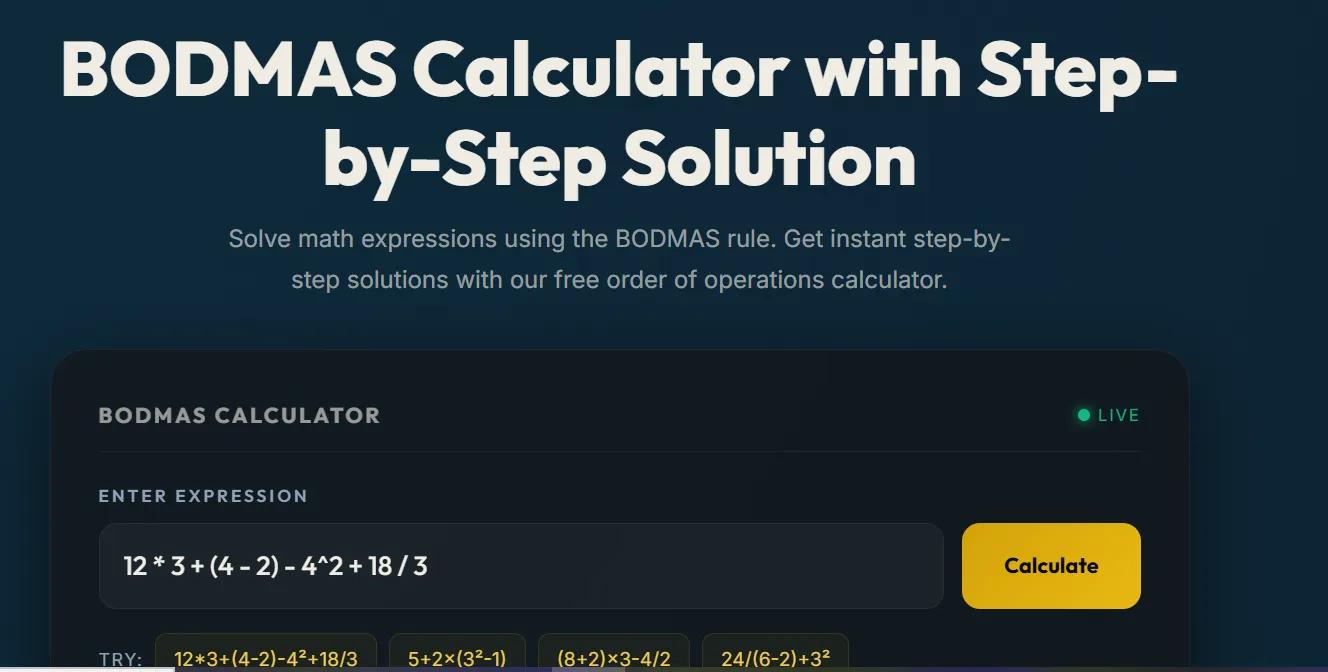
The fix isn't more repetition of the acronym. It's working through why each step exists, and getting enough low-stakes practice that the sequence becomes automatic rather than something to consciously recall under exam pressure. A simple BODMAS calculator can help here — not as a shortcut, but as a way to check your own step-by-step work and catch exactly where a mistake happened, rather than just seeing that the final answer is wrong.
The Trouble with Ratios
Ratios seem more concrete than BODMAS — after all, they show up in cooking, maps, and mixing paint. But they trip students up for a different reason: they blur the line between "parts of a whole" and "one thing compared to another."
Ratio vs. fraction confusion. A ratio of 2:3 doesn't mean "2 out of 3." It means two parts to three parts, out of five total. Students who haven't internalized this often set up the wrong equation entirely, even when their arithmetic is flawless.
Simplifying isn't intuitive for everyone. Reducing 12:18 to 2:3 requires spotting the greatest common factor — a skill that some students have automated and others are still counting through manually, which slows them down significantly on timed tests.
Scaling ratios up or down is where real-world application breaks. Word problems ask students to scale a ratio to a new total (e.g., "if the ratio is 2:5 and there are 35 items, how many are in each group?"), and this is genuinely a different skill from simplifying — it requires understanding proportional relationships, not just factor reduction.
Ratios show up disguised as other topics. Recipe scaling, map distances, mixing solutions, aspect ratios, financial ratios — students often don't recognize a ratio problem when it's dressed up as something else, so they don't reach for the right method.
Simplifying ratios by hand is a good exercise, but for students double-checking multi-step homework or working through several problems quickly, a simplify ratio calculator is a useful way to verify the reduced form and confirm the logic before moving on to the next step.
Why These Two Topics Belong Together
BODMAS and ratios aren't related by subject matter, but they're related by why they cause errors: both rely on a fixed sequence of small rules that need to become automatic. Rush either one, and small missteps compound into a wrong final answer, even when the student clearly understands the bigger concept.
The good news is that both skills respond well to the same kind of practice: slow, deliberate repetition early on, followed by tools that let students verify their own reasoning rather than just their final answer. Getting comfortable with why a step happens — not just memorizing that it happens — is what eventually makes both topics feel automatic instead of intimidating.