

Nobody talks about industrial heat at dinner parties. But walk into a textile dyeing unit in Rajasthan or a dairy processing plant in Maharashtra and ask the plant manager what his biggest operating cost is. Nine times out of ten, the answer is fuel — diesel, LPG, or furnace oil — used not to generate electricity, but to make steam and hot water. That's the problem parabolic trough technology was built to solve, and it's been solving it quietly in facilities across India, Chile, Morocco, and the American Southwest for years now.
According to the International Energy Agency, industrial processes consume close to 20% of global final energy demand. A large chunk of that is thermal energy below 400°C — temperatures where the parabolic trough collector operates comfortably, without any fuel combustion at all.
The Basics, Without the Textbook Version
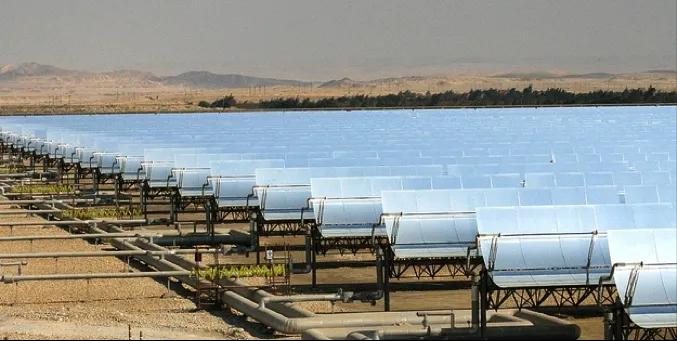
The collector itself is simple in concept. A long, curved mirror — shaped like a half-pipe cut lengthwise — focuses incoming sunlight onto a receiver tube running along its focal line. Inside that tube, a heat transfer fluid absorbs the concentrated heat and carries it into whatever process needs it.
Concentration ratios typically fall between 70:1 and 80:1. What that actually means: the system can push fluid temperatures to 390–400°C on a clear day, without any supplemental heating. The trough tracks the sun on a single axis, rotating east to west as the day progresses. Single-axis tracking is a deliberate engineering choice — it's far cheaper and easier to maintain than dual-axis alternatives, and the energy output trade-off is marginal for most applications.
The heat transfer fluid has historically been synthetic oil. Direct steam generation and molten salt are now viable alternatives, though each comes with its own integration considerations.
Where These Systems Are Actually Running
Food and beverage processing is one of the most natural fits. Pasteurisation at 80–90°C, sterilisation, drying — the thermal loads are predictable and the temperatures are modest. A dairy plant running two shifts a day doesn't need variable electricity. It needs steady, reliable heat. Parabolic trough systems tied to storage tanks deliver that. The boiler still runs as backup, but fuel bills drop significantly.
Chemical and pharmaceutical plants present a different profile. Process heat requirements there often sit between 150°C and 300°C — synthesis, distillation, drying of intermediates. These facilities tend to run around the clock. Parabolic trough arrays paired with thermal storage work well here precisely because the load never really stops.
Textile and leather processing is worth mentioning specifically for the Indian context. Several facilities across Surat and Tirupur have run trials using solar steam generation to offset boiler consumption. Numbers vary by site, but reductions of 30–50% in fuel use during peak solar months are not unusual. The challenge is usually retrofitting — integrating a new heat source into a process line designed around a centralised boiler.
Mining is perhaps the least obvious application but economically one of the strongest. Remote sites in Rajasthan, northern Chile, and Western Australia pay extraordinary prices for diesel. Heap leaching, mineral drying, and evaporation processes need heat, not electrons. A parabolic trough field requires land, which remote mining sites have. The capital payback periods in high-irradiance, high-fuel-cost locations can be under seven years.
The Renewable Energy Project Side
Beyond industrial heating, the parabolic trough collector is the foundation of most large concentrating solar power (CSP) plants built before 2015. The reason CSP attracted serious grid-scale investment was thermal storage — something photovoltaic plants still can't replicate cheaply.
Abengoa's Solana plant in Arizona runs with six hours of molten salt thermal storage. After sunset, the stored heat drives steam turbines. That's dispatchable solar — power you can schedule like a gas plant. Grid operators in markets with aggressive renewable targets will pay a premium for that reliability.
Hybrid renewable configurations are getting more attention now. A solar-thermal system combined with biomass or geothermal covers periods of low irradiance without battery storage. From a project finance perspective, a hybrid plant with measurable heat storage is more bankable than a pure PV installation. The revenue certainty is better.
For engineers doing feasibility work or building research capacity around these systems, understanding the underlying performance models — optical efficiency curves, incidence angle modifiers, thermal loss coefficients — is the starting point for any honest project assessment. The working principles and power generation mechanics of the parabolic trough collector are covered in detail in this technical resource, which is useful groundwork before moving into site-specific modelling.
What It Doesn't Do Well
Direct normal irradiance (DNI) is the hard constraint. Parabolic troughs only focus direct sunlight — diffuse radiation on a cloudy or hazy day is essentially useless to them. The commonly cited viability threshold is annual DNI of 1,800 kWh/m² or above. That rules out most of northern Europe, parts of East Asia during monsoon-heavy months, and coastal sites with chronic cloud cover.
Land is another constraint that gets underestimated in early-stage assessments. A 100 MWe CSP plant can require 200–300 hectares depending on the collector field layout and storage design. In industrial settings, land availability near an existing process plant often limits how large a solar field you can actually build.
Synthetic oil degradation is a routine maintenance issue, not a catastrophic one — but it does require monitoring and periodic replacement. Facilities that have never managed a heat transfer fluid loop need to build that operational capability, or budget for a service contract.
What's Changing Now
Two directions are worth watching.
Receiver tube technology is improving. New selective coatings with lower emissivity, combined with improved vacuum jackets, are pushing operating temperatures toward 500–550°C. That range opens access to industrial processes currently locked into gas — certain chemical reactions, advanced drying processes, and high-pressure steam applications.
Green hydrogen is the second shift. Parabolic trough systems in high-DNI locations are being evaluated as thermal inputs to high-temperature electrolysis processes. The U.S. Department of Energy's Solar Futures Study specifically names concentrated solar heat as a pathway for industrial decarbonisation through 2035. Whether that translates to widespread commercial deployment in this decade depends on electrolyser cost curves and hydrogen policy more than on the solar technology itself.
The parabolic trough collector isn't a speculative technology waiting for its moment. It's operating in industrial facilities right now, reducing fuel bills, and enabling CSP plants to deliver dispatchable power. The question for any new project isn't whether the technology works — it's whether the site conditions, process temperatures, and capital structure align. That's an engineering and finance question, not a technology question.